
Welcome to the Learning without Limits project
The Learning Without Limits project is dedicated to developing approaches to teaching and learning that do not rely on determinist beliefs about ability. The project is inspired by decades of research that have drawn attention to the many complex ways in which ideas of fixed ability, and the practices based on them, can limit learning.
The Learning without Limits project began in the late 1990s when Susan Hart wrote A Sorry Tail about the long tail of underachievement in schools (Hart, S. (1998) 'A Sorry Tail: Ability, Pedagogy and Educational Reform', British Journal of Educational Studies, 46(2), pp.153-168). The subsequent two books, Learning without Limits and Creating Learning without Limits, drew on empirical research into the work of teachers who were doing things differently in their work with children and young people. The special issues of the Journal Forum (Forum 55.1 and Forum 61.1) address aspects of Learning without Limits and are freely available online: FORUM - Lawrence Wishart (lwbooks.co.uk)
We worked consistently over the years with school-based colleagues in a Network, and on CPD and Masters courses to disseminate and develop the Learning without Limits theoretical framework for practice. The Network was invaluable in consolidating principles, spreading ideas, sharing experiences, illuminating difficulties and dilemmas, and re-confirming for all of us that those who try to teach without notions of fixed 'ability' are not alone.
RESEARCH
With the support of colleagues from the Leadership for Learning network, we held a two-day study tour for Headteacher, Stein Larsen, and his staff (51 in total) from the Ortun Secondary School, Bergen, in Norway. Following a day spent exploring the principles and values of the Learning without Limits research at the Faculty of Education in Cambridge, the group then spent a day at The Wroxham School, hosted by then head teacher, Alison Peacock, co-author of Creating Learning without Limits. Further research, funded by the Isaac Newton Trust and ESRC, has now been carried out to learn how these ideas are being developed by our Norwegian colleagues.
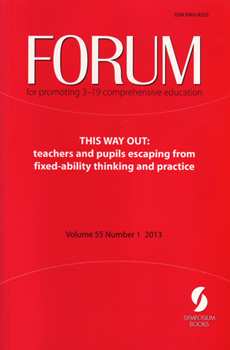
PUBLICATIONS: Two special issues of the journal FORUM
(vol 55, no 1, 2013 and vol 61, no 1, 2019)
See also the Related Work area of the website for links to the challenging and inspiring accounts of the ideas and practices of a selection of teachers, academics and researchers who are committed to developing teaching and learning approaches free from limiting ideas about ability.
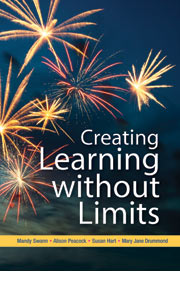 An alternative approach to whole-school development
Creating Learning without Limits, published by Open University Press in 2012, builds on the findings of the first Learning without Limits study (see below). Co-authored by Mandy Swann, Alison Peacock, Susan Hart and Mary Jane Drummond, it tells the story of how one primary school community worked to build a learning environment that is inclusive, humane and enabling for everybody, a place free from the damaging effects of fixed ability thinking and practices. Further information about the project aims and methods can be found on the Creating Learning without Limits project pages.
Original study and book
Our first study (1999-2002) set out to analyse the practices of individual teachers who had rejected ability-based approaches. We found that, in place of the notion of ability, a sense of 'transformability' permeated every aspect of their work: the conviction that things can change and be changed for the better, sometimes even dramatically, as a result of the choices that people – both teachers and children - make in the present. Further information can be found on The First LWL Project pages. The key concepts and principles of transformability-based pedagogy are elaborated in detail in our award-winning book, 'Learning Without Limits', published by Open University Press in 2004, described by Professor Tim Brighouse as a 'book that could change the world'.
Building a network
Related work by other colleagues, in the UK, Europe and US, can be found by following the link.
Previous projects laying foundations for the development of a network include: